
Nepal's foreign investment rules are open in principle, but they are not open at any size. The law sets a minimum entry amount, and that figure shapes the structure, the approval route and the amount of capital that must be recorded at Nepal Rastra Bank. For most investors, the number to plan around is NPR 20 million.
This guide explains what the minimum means, what it covers, when it applies, and the mistakes that cause an otherwise viable project to fail at the approval stage.
Quick answer
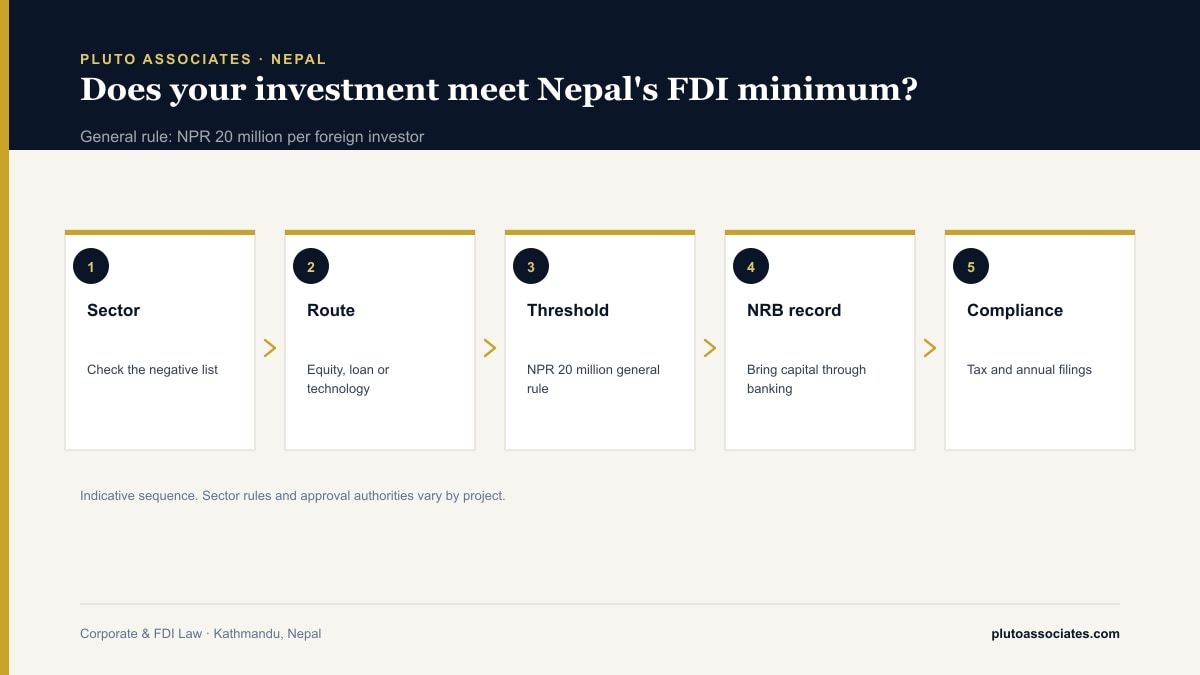
The general minimum foreign investment in Nepal is NPR 20 million per foreign investor under the Foreign Investment and Technology Transfer Act, 2075 (FITTA) and the rules made under it. The threshold was reduced from NPR 50 million in October 2022. It is not a fee, and it is not the same as the company's paid-up capital. It is the minimum amount of foreign investment that must be approved and brought into Nepal through banking channels. Sector-specific exceptions and NRN concessions should be confirmed before you structure the investment.
| Item | Detail |
|---|---|
| General minimum | NPR 20 million per foreign investor |
| Legal basis | FITTA 2075 and the rules made under it |
| Change | Reduced from NPR 50 million by gazette in October 2022 |
| Who it applies to | Foreign investors, including foreign companies and eligible NRNs, subject to sector rules |
| What it is not | A government fee, or the same thing as authorised or paid-up capital |
| Capital route | Banking channels, recorded with Nepal Rastra Bank |
| Approval authority | Department of Industry, or Investment Board Nepal above the statutory threshold |
| Typical timeline | Three to five months end to end |
| If the minimum is not met | Approval may be refused, or the structure must be revised |
What the NPR 20 million minimum actually means
The minimum is an entry threshold for foreign investment. It is the amount the foreign investor must commit and bring into Nepal under an approved investment. It is not a fee paid to the government, and it does not disappear into a licence. It becomes capital in the Nepali company, or the approved investment vehicle, and it must be documented from the first remittance.
That documentation is what makes the investment usable later. Nepal Rastra Bank records the inflow, and that record is the evidence you rely on when you want to repatriate dividends, sale proceeds or capital on exit. An investment that is approved but not properly recorded can create a repatriation problem years later, even if the business itself is successful.
Is the minimum per investor or per company?
The general rule is expressed per foreign investor, not per company. That distinction matters in a joint venture. If two foreign investors each subscribe to shares, the DOI will look at the structure and the proposed shareholding when applying the threshold. Do not assume that a single NPR 20 million investment covers an unlimited number of foreign shareholders, and do not split an investment artificially to avoid the rule. Confirm the treatment with the DOI before you draft the shareholding.
What counts toward the minimum
Foreign investment can take several forms: equity in a Nepali company, a shareholder loan, reinvestment of profits, or a technology transfer arrangement. The minimum threshold is generally measured against the foreign equity investment. A shareholder loan or a technology transfer fee is a separate component and should not be assumed to satisfy the equity minimum on its own.
In-kind contributions, such as plant, machinery or equipment, can form part of the investment. They require valuation, customs clearance where applicable, and NRB approval. The value attributed to the goods must be documented and consistent with the approval. An inflated valuation creates problems at the banking and tax stages, and an undervaluation can leave the investor short of the threshold.
Sector exceptions and the negative list
The minimum applies alongside sector eligibility rules. Nepal maintains a negative list of activities that are restricted or closed to foreign investment. If your activity is on the list, the question is not how much you plan to invest; the activity cannot be approved in that form. Sector-specific rules can also impose different thresholds or conditions, so confirm the current position for your activity before you commit capital.
Some routes are treated differently. NRNs invest under FITTA and may have access to concessions, and certain sectors are subject to their own approval regimes. These are policy details that change, which is why the threshold should be checked at the time of investment rather than assumed from an older guide.
Information technology and digital services are the clearest exception. Following the October 2023 notice, foreign investment in the ICT sector is exempt from the minimum threshold. The approval and NRB recording requirements still apply, and the exemption should be confirmed for the specific activity.
The minimum is not the same as paid-up capital
Paid-up capital is the amount shareholders have actually subscribed and paid for their shares. The FDI minimum is the foreign investment threshold. For a foreign-owned company, the two should be aligned: the approved foreign investment, the issued share capital and the memorandum and articles of association should describe the same structure. A mismatch is one of the most common reasons a filing is returned or a bank delays the capital recording.
Authorised capital is a separate concept again. It is the maximum capital the company may issue, and it drives the OCR registration fee. Setting authorised capital higher than necessary increases the fee without helping the FDI approval. Set it to match the approved investment and the company's actual funding plan.
How the capital must enter Nepal
Capital must come in through formal banking channels and be recorded with Nepal Rastra Bank. The remittance should state the correct purpose, such as share investment or loan investment, and the amount should match the approval. The commercial bank handles the NRB reporting, and the investor should keep the remittance advice, the NRB record and the company's share register together.
Informal channels, offset arrangements and under-invoicing are not substitutes. They may move money, but they do not create a recognised investment. The consequence usually appears at the point of repatriation, when the bank and the regulator ask for evidence that the capital entered lawfully. By then, the problem is expensive to fix.
What happens if you invest less
If the proposed investment falls below the applicable minimum, the DOI may refuse the application or require the structure to be revised. In some cases, a different route or a different sector may have a lower threshold, but that is a legal question, not a workaround. Splitting an investment between related parties or using a nominee to stay under the threshold creates regulatory and repatriation risk.
A worked example
A Dubai-based investor wants to own 100% of an IT services company in Nepal. The general minimum is NPR 20 million, so the project is structured around that figure. The investor files for FDI approval, incorporates the private limited company at the OCR, opens a corporate bank account and remits the capital through banking channels. The bank reports the inflow to Nepal Rastra Bank, and the investor keeps the NRB record with the share register and the approval letter.
If the same investor had remitted only NPR 15 million, the approval and the capital record would not match. The company might still be incorporated and trading, but the shortfall would surface when the investor later applies to repatriate dividends or sale proceeds. Fixing it at that stage requires additional approvals, bank reconciliation and time.
Timeline and costs
A straightforward FDI approval usually takes two to six weeks after a complete filing, and the full sequence from approval to recorded capital commonly runs three to five months. Document legalisation, translation and banking delays are often the largest variables. Government fees depend on the company's authorised capital and the applicable schedules, while professional fees depend on the structure, the project report and the sector.
Common mistakes
- Incorporating before FDI approval. The approval comes first, and the company documents should match it.
- Sending capital before approval. Money that arrives early is difficult to recognise and can stall the file.
- Under-invoicing or using informal channels. The capital may not be recognised for future repatriation.
- Assuming the minimum is per company. The general rule is per foreign investor, so confirm the shareholding structure.
- Ignoring sector rules. A negative-list activity cannot be fixed by increasing the investment.
Frequently asked questions
Is the minimum NPR 20 million per investor or per company?
The general rule is NPR 20 million per foreign investor, not per company. If more than one foreign investor subscribes, confirm how the DOI will apply the threshold to the proposed shareholding.
Can I invest less than NPR 20 million?
Generally no for a standard foreign investment. Some sectors and NRN routes may be treated differently, so confirm the current position with the DOI before structuring a smaller investment.
Does the minimum apply to loans and technology transfer?
The threshold is generally measured by foreign equity investment. A shareholder loan or technology transfer fee is a separate component and should not be assumed to satisfy the equity minimum.
Can I bring the capital in stages?
Often yes, if the approval and project plan allow it. The total approved investment must still meet the minimum, and every tranche must enter through banking channels and be recorded at NRB.
What if my investment is in machinery or equipment?
In-kind contributions can form part of the investment, but they require valuation, customs clearance and NRB approval. The value attributed must be documented and consistent with the approval.
Is the minimum the same as paid-up capital?
No. The minimum is the foreign investment threshold. Paid-up capital is the amount shareholders have actually subscribed. For a foreign-owned company, the two should be aligned in the approval and the charter.
Do NRNs have a lower minimum?
NRNs invest under FITTA and may have access to concessions or different treatment. The rules change, so confirm the current threshold for your route before relying on a lower amount.
Does the minimum apply to IT companies?
No. Following the October 2023 notice, foreign investment in information technology and digital services is exempt from the minimum threshold. The FDI approval and NRB recording requirements still apply.
What happens if I use informal channels or under-invoice?
Capital that is not brought in through banking channels and recorded at NRB may not be recognised for repatriation. That can block dividends, sale proceeds and exit payments later, and may create regulatory exposure.
Related guides: FDI registration process, company registration in Nepal, repatriating profits, branch, liaison or subsidiary.
How Pluto Associates can help
We advise foreign investors on the minimum investment threshold, the approval route and the capital recording sequence. If you would like a clear view of your own project, contact our team for a consultation, message us on WhatsApp, or call +977 9802356987. We will tell you what is possible, what it costs, and how long it takes.
Disclaimer: This article is general information, not legal advice. FITTA thresholds, sector rules and NRB procedures can change. Confirm the current position for your project with the Department of Industry, Investment Board Nepal and Nepal Rastra Bank before committing capital.